

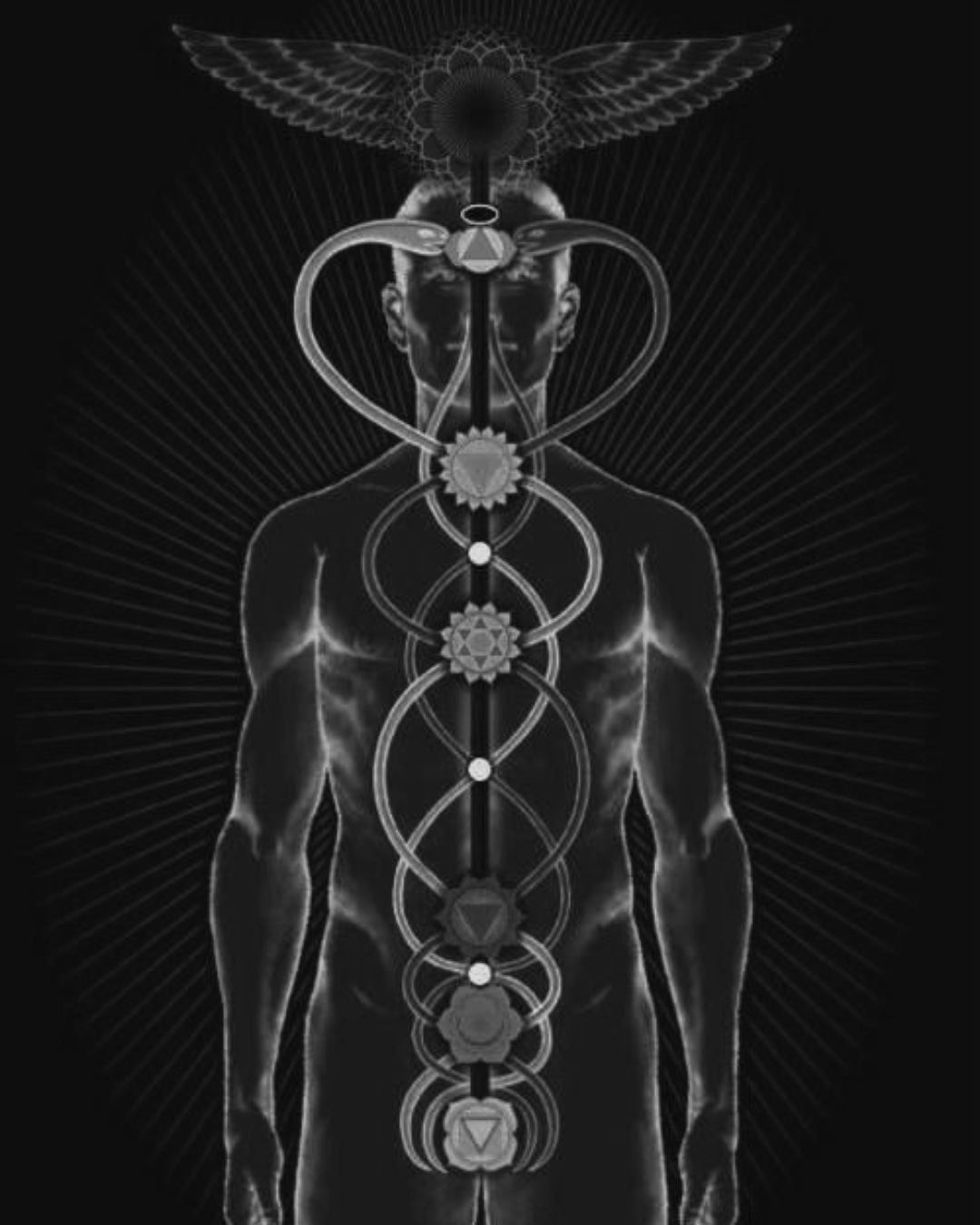
“We are not human beings having a spiritual experience. We are spiritual beings having a human experience.” — Pierre Teilhard de Chardin
Most of us have at least one area of life where effort consistently fails to produce results. That is not because we are failing in some way, but because the center in the body that governs that domain is operating through a distortion. You can want love and do everything right and still repel it, because the center that governs love does not believe you deserve it. You can work relentlessly toward a goal and watch it collapse at the same stage every time, because the center that governs manifestation learned early that success is dangerous. You can know exactly what you need to say and still not say it, because the center that governs your voice was shut down before your even learned to speak.
These are not psychological problems in the conventional sense but structural ones. There are seven Intelligence Centers that run along the center of the body, corresponding to what most traditions call the chakras, and each governs a specific domain of human experience. When a center is healthy, that domain of life works well. When it carries an injury, usually acquired in childhood, it filters everything you try to create through the logic of that injury, and the injury is rarely the original event itself but the pattern that continues in you, re-creating itself in different forms. You do not need to understand the origin to begin healing it, and the first step is to find which center is distorted and work with it directly.
Functions, Blocks, and Healing of the Seven Centers
First · Root · Survival
Base of the spine. Governs safety, belonging, and your basic right to exist.
Healthy: Your presence itself is stabilizing, to yourself and to the people around you. You feel grounded regardless of external circumstances. You are able to provide structure and consistency for yourself and others.
Wounded: Chronic instability that persists no matter how secure your actual situation is. Money in the bank, a home you own, a relationship that is solid, and still the feeling that the ground could give way at any moment. The fear is not proportional to the present but to whatever happened when this center was forming.
What heals it: Consistent, loving self-care. Taking care of mammalian needs. Regular sleep, nourishing food, physical safety, reliable routines. Not rigid discipline but the steady structure of treating your body as something worth protecting. The first center does not heal through insight but through sustained, boring, embodied safety.
Second · Sacral · Desire
Below the navel. Governs pleasure, creativity, nourishment, and your capacity to receive.
Healthy: You take in what life offers, enjoy it without guilt, and set boundaries that protect you without closing you off. Resources flow toward you and you are able to hold them.
Wounded: Depletion, difficulty receiving, creativity that starts and stalls, a pattern of giving everything and resenting it. Eating disorders, codependence, and chronic difficulty with abundance often trace back here. You may be wide open with no filter, absorbing everything around you, or so defended that nothing gets in.
What heals it: Learning to notice satiety. Not just with food but with everything: attention, work, relationships, giving. The second center heals when you learn to recognize the difference between nourishment and depletion in real time, and to act on that recognition even when guilt or obligation tells you to override it.
Third · Solar Plexus · Power
Above the navel, below the chest. Governs drive, will, and your capacity to manifest.
Healthy: You set goals and reach them, recover from setbacks, and your effort has traction. You know what you are building and why, and you have enough internal structure to sustain effort over time.
Wounded: Effort without traction, scattered intention, vitality that drains before anything is complete. You may also cultivate conflict unconsciously, because this center’s energy, when it has no clear direction, turns destructive, and burnout often lives here.
What heals it: Finding your purpose. Not purpose in the grand existential sense, though that helps, but in the functional sense: a clear answer to “what am I building and why?” that is honest enough to sustain you when the work gets hard. The third center also heals through learning when to stop pushing, because the wound here often expresses as relentless effort that never quite gets anywhere.
Fourth · Heart · Love
Center of the chest. Governs love, worth, and your sense of dignity.
Healthy: You attract love, receive recognition, and feel deserving of what you want without needing constant external validation. Your relationships are mutually nourishing. You can hold boundaries without guilt and receive generosity without suspicion.
Wounded: Achievements that feel hollow, pushing love away or clinging to it in forms that diminish you, holding yourself to perfectionistic standards that guarantee you will never feel enough. You may give away what belongs to other centers, sacrificing pleasure, voice, or safety in exchange for the feeling of being valued.
What heals it: Genuine self-worth, which is different from self-esteem. Self-esteem can be inflated or borrowed, but self-worth is the quiet recognition that your value does not depend on what you produce or who approves of you. This center also heals through forgiveness, not because forgiveness is spiritually correct but because it reclaims the parts of yourself that are wastefully engaged with the experience of harm.
Fifth · Throat · Expression
Throat. Governs voice, truth, and your capacity to be known.
Healthy: You speak honestly, set boundaries with clarity, and attract trustworthy guidance when you need it. People experience the real you, and your voice has impact.
Wounded: Staying small in rooms where you should speak, being known but never quite seen, carrying family secrets or unspoken truths that distort your relationship with reality. You may have constructed a version of yourself that you present to the world as real, and because no one knows the person beneath it, your actual gifts remain hidden, even from you.
What heals it: Truth, in the sense of an honest engagement with what is actually happening in your body, your relationships, and your life right now. The fifth center heals every time you say the thing you have been not saying, even when it is small, even when your voice shakes.
Sixth · Third Eye · Perception
Between the eyebrows. Governs intuition, intellect, and vision.
Healthy: Feeling and thinking work together, and your intuition functions with ease, giving you accurate reads on people and situations that you trust enough to act on.
Wounded: Overthinking, distrust of instinct, knowing things but being unable to act on them. Many highly intuitive people have a wounded sixth center, because the same sensitivity that makes them perceptive also made them vulnerable as children, and the center learned to protect itself by retreating into analysis, intellectualizing feelings rather than feeling them directly.
What heals it: Learning to let intuition and intellect work together rather than letting one override the other. Practically, this means noticing when you are using thinking to avoid feeling, and when you are using feeling to avoid the discipline of clear thought. The sixth center heals when perception and action are no longer separated by doubt.
Seventh · Crown · Meaning
Top of the head. Governs your capacity to access and channel something larger than yourself.
Healthy: Synchronicity is a regular feature of your life, you know when to surrender and when to act, and you experience ease, not the absence of difficulty but the capacity to meet difficulty without contracting against it. You feel connected to something that exceeds your individual identity.
Wounded: Controlling, forcing, inability to receive what arrives without struggle, or the opposite, using spirituality to escape the difficulty of being human, known as spiritual bypassing. The flight into transcendence can look like the most evolved response, but it is often a refusal to do the harder work of being fully present.
What heals it: The willingness to be here, not to transcend your humanity but to metabolize it. The seventh center heals when you stop treating your human limitations as obstacles to spiritual development and start treating them as the material through which that development happens.
Most of us carry wounds across multiple centers, and a wound from one center often affects another. A wounded fourth center in the heart will reinforce a wounded fifth center in the throat, because if you do not believe you are worth hearing, you will not speak. A wounded first center in the root will undermine everything the third center in the solar plexus is trying to build, because you cannot manifest from a foundation of fear. The centers are a system, and the patterns they create can affect a whole life without the person ever realizing that the same injury is expressing itself in their relationships, their finances, their health, and their creative life simultaneously.
Fortunately, the system works in your favor once you begin healing it. Healing one center often unlocks the one above it or below it, because the same interconnection that allowed the wounds to reinforce each other allows the healing to cascade. You do not have to resolve everything before you move forward, and you do not need to do this work alone. What I have found in my own life and in the lives of the people I work with is that we each carry what Bill Plotkin calls a “sacred wound” in The Journey of Soul Initiation, a center that is the source of our deepest pain but that through healing, becomes the source of our greatest power.
Intuitive Intelligence Practice
Finding Your Blocked Center
This practice helps you identify which Intelligence Center is carrying the wound that is most actively shaping your life right now. Give yourself fifteen minutes.
Read back through the seven centers above and notice which description produced the strongest physical response, not the one you think applies to you intellectually but the one that made your body react: a tightening, a heat, a sudden emotion, a desire to skip past it.
Write down the center and the specific pattern you recognize. Be concrete. Not “I have trouble with love” but “I keep choosing people who make me prove my worth, and when someone offers love freely I feel suspicious of it.”
Now ask: how old is this pattern? Not when did it start, because you may not remember, but how old does it feel? When your body contracts around this pattern, how old is the part of you that is contracting?
Finally, notice whether you have been trying to solve this pattern from a different center than where it lives: trying to think your way through a heart wound, or will your way through a safety wound, or love your way through a voice wound. The solution has to meet the problem where it actually is.
Still Curious?
Anodea Judith’s Wheels of Life: A User’s Guide to the Chakra System remains one of the most rigorous explorations of the chakra system as a developmental map rather than an abstract energy model. Judith trained in both somatic therapy and bioenergetics, and the book grounds each center in psychology, physiology, and lived experience.
Nina Guilbeault, PhD is a coach, author, and intuitive helping people and organizations develop their Intuitive Intelligence.