

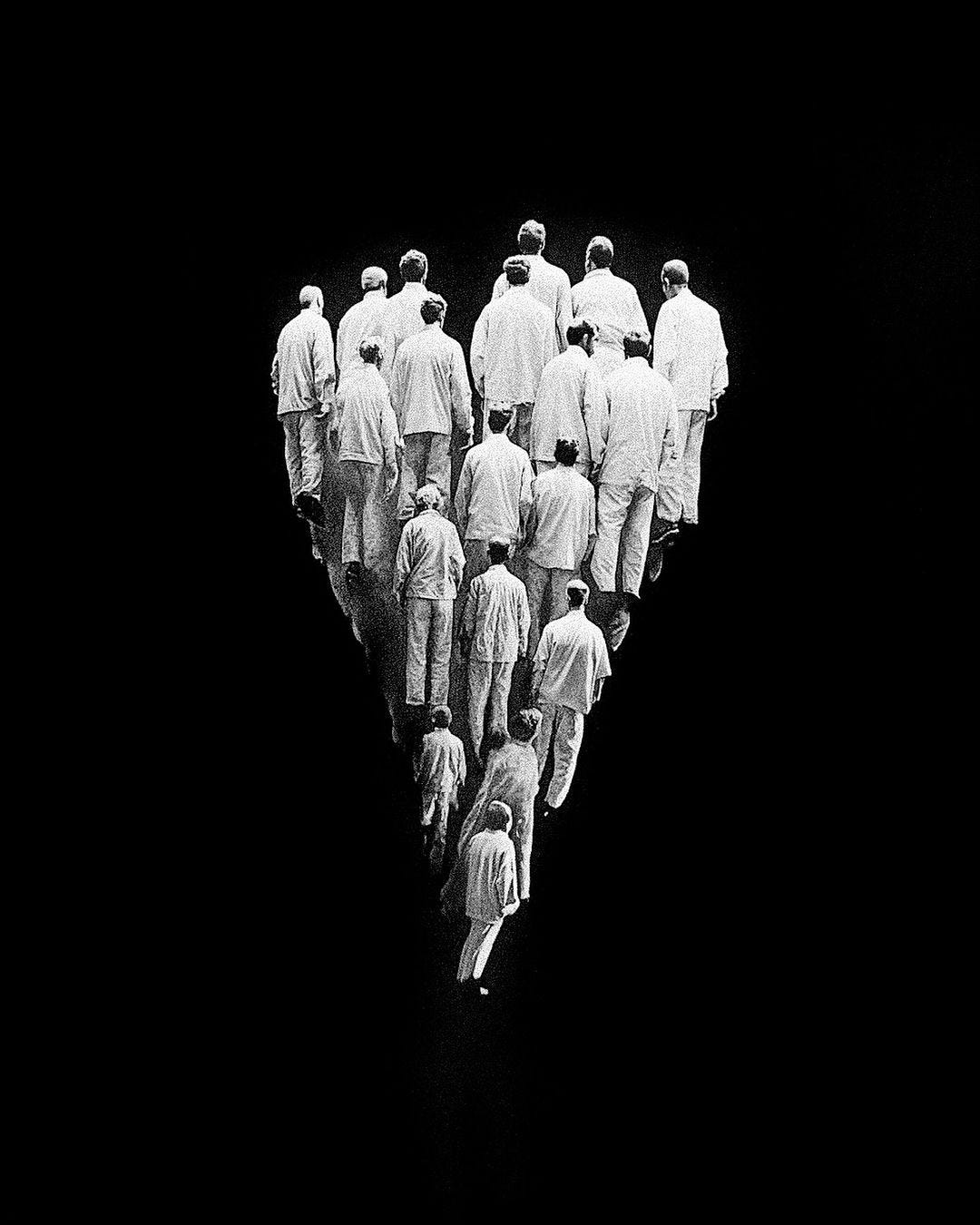
“The field is the sole governing agency of the particle.” — Albert Einstein
In many traditions, indigenous, contemplative, ancestral, consciousness is understood as something inherent to reality itself, not something that exists in individual minds. The practices these traditions developed for accessing collective knowing were not primitive precursors to modern collaboration but sophisticated technologies for generating what I call a resonance field: the emergent intelligence that arises when a group of people move out of their individual analytical minds and into shared, embodied presence together.
The Quaker practice of “waiting worship” involves a community sitting in shared silence until someone feels moved to speak, and what emerges is understood to come through the individual but not from them. Indigenous council practices around the world use circular formats where speaking and listening are governed by protocols designed to distribute attention across the group rather than concentrating it in any one voice. Meditation circles, ceremonial containers, and healing traditions across Africa, the Americas, and Asia all share the same underlying architecture: a structure that quiets the individual mind enough to let the collective field speak.
The Science of Collective Wisdom
We have largely lost access to this in modern life, not because the capacity has atrophied but because we have built a civilization around the assumption that intelligence is individual, that knowing happens inside separate heads, and that the best way to make a group decision is to have separate people think separately and then argue their way to consensus. The research suggests this assumption is wrong. In a landmark 2010 study published in Science, Anita Woolley and colleagues at Carnegie Mellon and MIT’s Center for Collective Intelligence tested 699 people in groups of two to five across a wide range of tasks and found converging evidence for what they called a “c factor,” a general collective intelligence that predicted group performance across every kind of task they measured.
The finding that reframed the entire field was this: the c factor was not correlated with the average or maximum individual intelligence of the group members. The smartest people in the room did not make the group smarter. What did predict collective intelligence were three things: the average social sensitivity of group members, meaning how well they could feel each other; the equality of conversational turn-taking, meaning whether the field was distributed or dominated; and, as a downstream effect of both, the proportion of women in the group. What Woolley’s team measured and called collective intelligence is what the traditions have always known and what I would describe in different language: the strength of the resonance field.
Uri Hasson’s lab at Princeton has been studying the neural mechanism underneath this. In a 2010 study published in PNAS, Hasson and colleagues used fMRI to record brain activity from groups engaged in natural communication and found that when genuine connection was present, neural activity across individuals became spatially and temporally coupled, their brains literally synchronizing in real time. Hasson compared it to metronomes placed on a shared platform: the vibrations travel through the platform until the metronomes lock into the same rhythm, and brains, he argued, “tick together” in the same way when people are genuinely present with one another.
In a subsequent paper, he and his co-authors called for a shift from a single-brain to a multi-brain frame of reference, arguing that the behaviors and cognitions that emerge from neural coupling “could not have emerged in isolation.” What is remarkable about both of these research programs is that they arrived, through entirely different methodologies, at the same conclusion the contemplative and indigenous traditions reached thousands of years ago: that human intelligence is not only individual but collective, that it operates through fields of shared attention and mutual sensitivity, and that when those fields are strong, the group becomes capable of perceptions and decisions that exceed what any member could produce alone.
Creating Coherence
Think of it like musical instruments tuning together. When individual instruments play separately, you hear separate sounds. When they tune to the same frequency and attend to one another, harmonics emerge that no single instrument could produce on its own. The harmonics do not live in any one instrument but in the resonance between them, in the field their shared attention generates. A resonance field is what emerges when a group of people build that coherence deliberately, when each person is no longer performing their separate intelligence but is open, attentive, and available to what wants to come through the collective.
I have seen this operate in founding teams making pivotal decisions, in groups of friends holding space for someone in crisis, in classrooms where the conversation suddenly deepened beyond what any one person was bringing, in ceremonies where strangers sat in silence and something moved through the room that none of them generated individually, and in spiritual circles where people who had never met independently reported the same images, sensations, or phrases and someone named the thing that everyone in the room felt but no one had said. This is not groupthink, which operates through social conformity and produces agreement at the expense of accuracy, but its opposite: a field so well-held that each individual’s perception becomes sharper and more honest precisely because the collective attention is amplifying the signal rather than diluting it.
How to Hold a Resonance Field
Holding a resonance field is an active practice, not a passive one. The group is not listening in the ordinary sense, not thinking about a situation or preparing responses, but being present to the collective system, each person open in their own channel, allowing what arises in response to the shared field to surface without forcing or filtering it. The distinction that matters is that thinking about a situation scatters the field while being with a situation amplifies it, and when a group holds the field well, every person in the room gains access to signal they could not reach individually. What arises while holding the field belongs to the field and is a gift, not yours to keep but yours to offer, and trusting it enough to share it simply, without interpreting or editing, is the practice. The group also functions as sacred mirrors for one another: what you see or sense about someone else is often also true for you, and what emerges through the field while someone else is being held may contain the clearest signal you receive.
The protocol I use for generating resonance fields is structured precisely because collective intelligence without structure collapses into either groupthink or chaos. Each person first identifies their own primary intuitive channel, whether body, vision, hearing, direct knowing, or energy, through a guided somatic practice, because you cannot contribute to a collective field if you do not know how you individually receive information. Then the group drops into shared silence and builds coherence together through breath and body awareness, practicing sensing the field itself rather than the individuals in it. When one person brings a challenge to the group, the collective holds attuned presence while that person drops into their own knowing, and the group is not problem-solving or giving advice but noticing what arises in their own channels. When the group reflects back what they sensed, the person at the center doesn’t receive opinions but data points from multiple perceptual systems operating simultaneously, and the overlap between what independent individuals perceived, the images or sensations or words that three or four people report without coordination, is consistently where the clearest collective signal lives.
The Value of Community
What makes this different from any conventional group process is what is being accessed. In a brainstorm or a meeting or a strategic planning session, you are pooling what people already know. In a resonance field, you are pooling what people perceive when they drop below what they already know, into the wider bandwidth of collective awareness that most of us were trained to ignore but that becomes unmistakable when a group builds enough coherence to access it together.
Every gathering of humans, whether it is a family navigating a crisis, a community holding space for grief, a circle of friends at a crossroads, or an organization facing a decision where the data points in every direction, has access to this capacity. We are leaving it unused in nearly every room we sit in together, and it is precisely the capacity that becomes more valuable, not less, as we enter an era where individual analytical intelligence can be outsourced but the collective felt intelligence that emerges when human beings are genuinely present with each other cannot be replicated, automated, or delegated to any system we have built or are likely to build.
Intuitive Intelligence Practice
Building a Resonance Field
You can begin experiencing collective intelligence with as few as three people and fifteen minutes. The minimum group size matters because a resonance field is a collective phenomenon, not a dyadic one, and even one additional person changes the quality of what becomes available.
Sit in a circle. Close your eyes and take a few slow breaths, letting your attention drop from your head into your body. Spend two minutes simply attuning to the shared space, not to any individual in the room but to the field between all of you, the container you are generating together. You are building coherence before you begin.
One person silently holds a real question or challenge they are working with, without sharing the question yet. Hold it lightly, as though you are offering it to something wiser than your individual thinking mind.
Everyone else sits in open, receptive attention, not trying to read the person or solve anything but being present to the collective field and noticing what arises in their own channel. If you are body-based, notice your gut or chest. If you are visual, soften your inner gaze. If you are auditory, listen inward. If you are a direct knower, simply open and receive. If you are energetic, notice what you are drawn toward or repelled by.
After three minutes of silence, each person shares what arose without interpretation or advice, just raw perception: “I felt tightness in my chest,” “I saw an image of water,” “The word patience came to mind.” What arose belongs to the field. Share it simply.
The person holding the question then shares what their question was. The group notices which perceptions overlap, which ones surprise, and which ones clarify. The convergences, the places where independent channels produced the same signal, are where the resonance field was strongest.
Rotate so each person has a turn at the center, then discuss what it felt like to receive collective intelligence, whether the signal was different in quality from what any individual could have produced alone, and whether what you sensed while holding the field for someone else also resonated with something true in your own life.
Still Curious?
If you want to experience a resonance field in person, I lead Intuitive Intelligence workshops for teams, founders, circles, and organizations. You’ll map your intuitive channels through guided meditation and somatic practice, build a resonance field together, and leave with a repeatable protocol for accessing collective intelligence in any group you are part of.
Nina Guilbeault, PhD is a coach, author, and intuitive helping people and organizations develop their Intuitive Intelligence.