

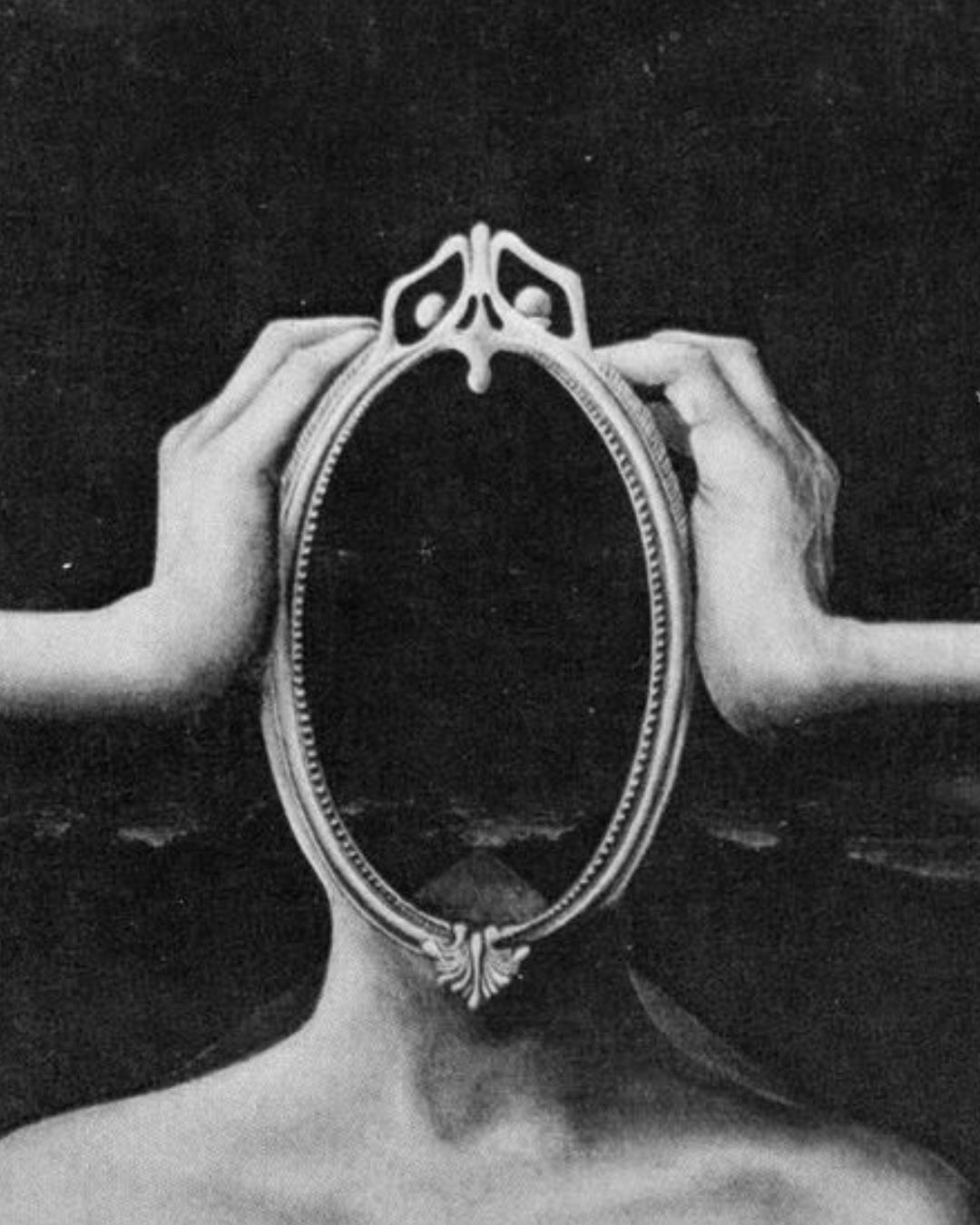
“The separation of the two, matter and spirit, is an abstraction. The ground is always one.” — David Bohm
Every spiritual tradition points to the same underlying claim: the physical world is not the primary reality, but a surface expression of something deeper and more interconnected. The Sufis called this deeper reality the imaginal. The Australian Aborigines call it the Dreamtime. The Tibetan Buddhists call it the dharmakaya, the body of truth from which all forms arise. The Hindus call it Brahman. The Hindu Visvasara Tantra describe it as: “What is here is elsewhere.” These traditions developed independently across thousands of years and thousands of miles, yet converge on the same claim about reality.
The Holographic Theory of Consciousness
In the twentieth century, physics began producing the same convergence from the scientific perspective. In The Holographic Universe, Michael Talbot draws on the work of physicist David Bohm, a protégé of Einstein, and neurophysiologist Karl Pribram at Stanford, who arrived independently at the same model: the universe operates like a hologram, where every fragment contains the whole. Bohm called the deeper level the implicate order, a domain where everything is enfolded into everything else and our familiar world of separate objects, what he called the explicate order, is the unfolded surface. The implications are vast: nearly everything we assume about the nature of reality might be wrong.
Bohm argued that every action starts as an intention in the implicate order, and that imagination is not invention but, in his words, “already the creation of the form; it already has the intention and the germs of all the movements needed to carry it out.” The twelfth-century Sufis arrived at the same conclusion through direct investigation of inner experience, using a term for the subtle matter of thought, Alam al-Mithal, and finding that by going deep enough into the psyche, you arrived at an inner world that turned out to contain the outer one. The kahunas of Hawaii held a parallel view: that thoughts become structures, and those structures become the strands from which the future is woven. These are not poetic metaphors but operational descriptions of a process, and they converge with Bohm’s physics on a specific and testable claim: what happens in consciousness precedes and shapes what happens in the physical world.
Implications for Inexplicable Phenomena
In a holographic model, the phenomena that our current paradigm treats as anomalies become predictable. Physicist David Peat called synchronicities “flaws in the fabric of reality,” moments where the deeper interconnectedness briefly becomes visible, and Carl Jung observed that they cluster around moments of psychological breakthrough. Talbot cites remote viewing research at Stanford Research Institute, where subjects accurately described what a distant person was seeing, a finding that is inexplicable under the standard model but straightforward in a holographic one, since distance is a property of the surface, not the depth. He also examines near-death experiences, in which people consistently report entering a domain where perception is more vivid and more real than ordinary waking life. If consciousness is the ground and the physical world is the projection, then waking life is more of a dream than we realize.
As Keith Floyd writes, “It may not be the brain that produces consciousness, but rather consciousness that creates the appearance of the brain, matter, space, time, and everything else we are pleased to interpret as the physical universe.” Talbot suggests that the relative scarcity of synchronicities and intuitive experiences in our lives may not reflect the limits of reality but the limits of our perception. Pribram believed there are entire dimensions of information in what he called the frequency domain that we simply aren’t registering, things our brains have learned to filter out because nobody ever trained us to process them. If that is true, then what we call “normal” perception isn’t a reliable baseline but a narrow slice of something much wider. As the Kalahari Bushmen put it, “The dream is dreaming itself.”
Intuitive Intelligence Practice
The Part That Contains the Whole
In a hologram, any single piece contains the entire image, and this practice works with that principle directly: instead of trying to figure out an answer, you let a single image arrive and trust that it carries more information than it appears to.
Sit quietly with a question you’re pondering in your life, something real, not hypothetical.
Close your eyes, take a few breaths, then silently ask the question once, the way you’d ask it to someone wiser than you, and stop.
Wait. Don’t think about the question. Just notice what arises. It might be an image, a color, a texture, a word, a sensation, a memory, a face. Whatever comes first, even if it seems random or irrelevant, stay with it.
Treat that fragment the way you’d treat a piece of a hologram: it contains the whole. Ask it, what are you showing me? Let it unfold. Follow where it leads without editing or interpreting.
If a second image or sensation arises from the first, follow that too. You’re not constructing anything but letting something that already exists reveal itself.
After five to ten minutes, write down what came. Don’t analyze it yet. The meaning often clarifies hours or days later.
Still Curious?
Michael Talbot on Thinking Allowed with Jeffrey Mishlove, “Synchronicity and the Holographic Universe”, recorded six months before Talbot’s death. He covers holographic brain functioning, the implicate order, and why the model opens the door to phenomena conventional science can’t explain.
Nina Guilbeault, PhD is a coach, author, and intuitive who helps individuals and organizations develop their Intuitive Intelligence.